
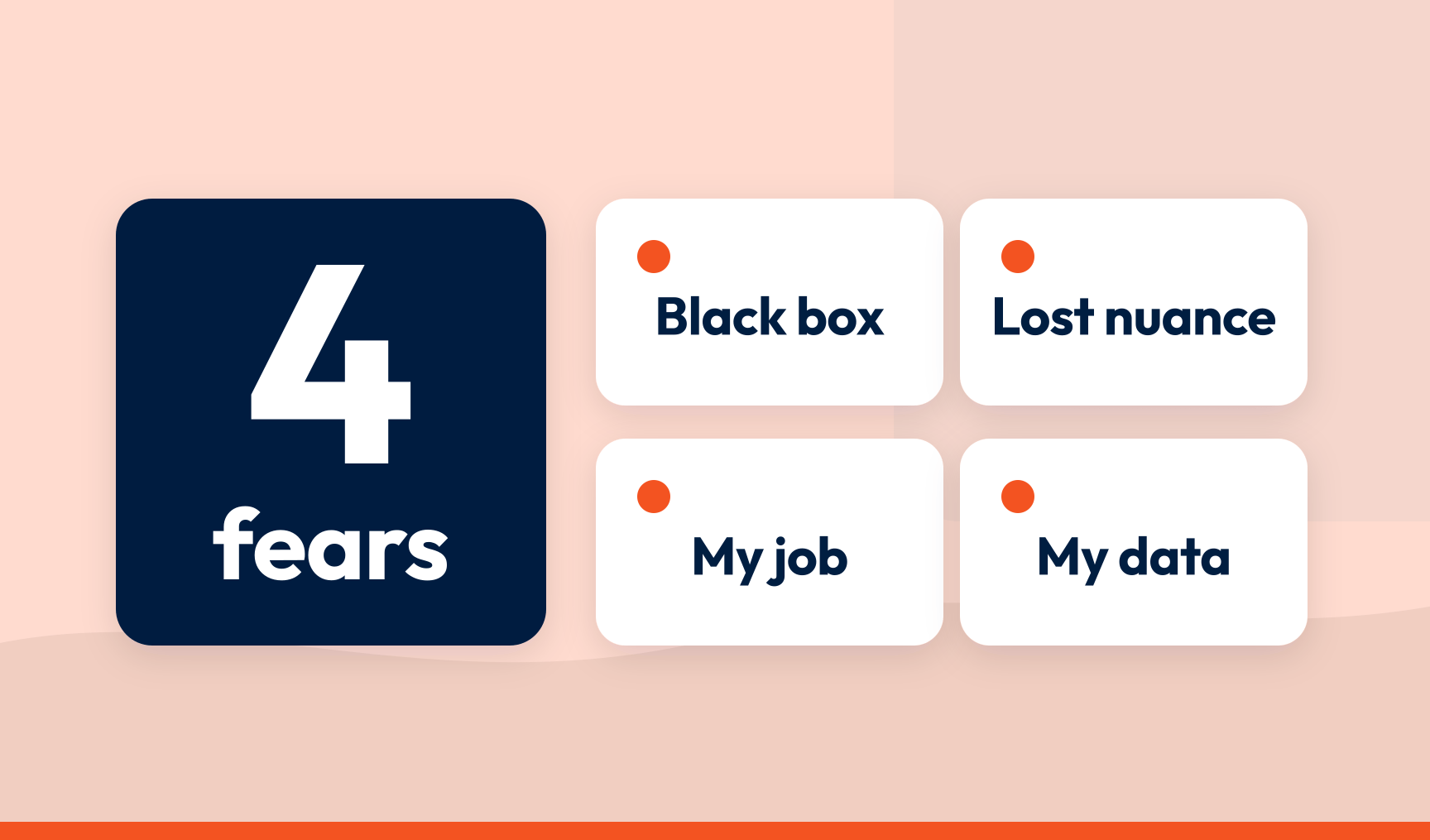
The concerns CX teams raise about AI are about the black box, not the AI. Can I see what it did? Can I check it? Will it flatten what people actually said? Does my job survive it? Where does the data go? Each has a good answer when the platform shows its work, keeps a person in the loop and treats your feedback as yours. Each has a bad answer when it doesn’t. Introducing AI well means making sure you get the first kind.
Key takeaways
- Nobody in your team is afraid of AI. They are afraid of a number they can’t explain in a meeting
- The fix for every fear is the same. Open the number and show the words behind it
- AI doesn’t replace the analyst. It replaces the tagging, and gives the analyst back their week
- Nuance dies when sentiment is scored per comment. It survives when it is scored per phrase
- Your feedback is customer data. Know where it sits, who else can see it, and what it is certified against
Someone senior has said the words ‘we should be using AI for this’.
Now it’s your problem, and you have a room full of people with views.
The analyst who has spent six years learning to read customer comments. The head of insight who signs off numbers to a regulator. The team lead who ran last quarter’s survey through a chatbot and got a summary that was confidently wrong. And the data protection officer, who hasn’t said a word yet and is the one to worry about.
Not one of them is against AI. They are against not being able to see what it did. Every fear in that room comes back to the same thing. So does every answer.
Fear one. I can’t see how it got there
The head of insight says it first. ‘If I can’t explain why the number is 22%, it isn’t going in front of the board.’
Good. That is the right instinct. A theme you can’t trace to real comments is an opinion with a percentage on it. If your only defence is ‘the AI said so’, you have swapped one black box for a shinier one, and the board will spot it inside a minute.
So start here. Can you open any number and see what’s underneath? Click the driver, read the comments, see the sentiment on each phrase. That is drilling down to the verbatim. A platform has it or it doesn’t. If it does, the black box is a glass box and the head of insight has their answer. If it doesn’t, no amount of reassurance should get it past procurement.
Then ask where the topics came from. Some tools turn up with a library of categories built for the industry, or for somebody else’s business. Your respondents keep mentioning something the library has no drawer for, so it lands in ‘Other’ and disappears. Topics discovered from your own feedback sound like your respondents, because that is where they came from. And when the business needs to track something specific, your team adds a category and it applies across every source from then on.
Fear two. It will lose the nuance
The analyst’s objection, and it is a good one. ‘People say three things in one comment. A machine turns that into one score and everything I would have caught is gone.’
They are describing a real failure. Score sentiment per comment and ‘great product, hopeless invoicing’ averages out to neutral. That is a lie about both halves.
The nuance the analyst is worried about lives at the phrase level. So ask where the sentiment is scored. Per mention, with each phrase filed under its own topic and carrying its own score, the product keeps its compliment and billing gets its complaint. Per comment, the analyst is right and you should keep looking.
Some comments will still be ambiguous, and a few will be read differently from how the analyst would have read them. That is true of any reader. The safeguard is the same as for everything else. A person opens the topic, reads the comments, and catches the handful that need a second look before a decision rests on them. Doing that properly is a discipline, and how to validate AI insights sets it out.
Fear three. It’s coming for my job
Nobody says this one out loud. Everybody is thinking it.
Here is what actually goes. The tagging. Read a comment, pick a category, next comment, four thousand times, watch the categories drift by Thursday. That job is gone, and nobody who has done it will send flowers.
What stays is the job the tagging was in the way of. Checking what the platform found. Bringing the context it doesn’t have, the courier change, the new store manager, the app release. Investigating the top driver until there is a process to change. Deciding which of three drivers gets the team this month. Following the fix through to the people who own it and proving it worked.
That is analysis. Tagging was admin.
Tell the analyst that, in those words. Then show them the drill-down. The usual reaction is relief.
Fear four. Where does the data go
The DPO’s question, finally asked, and the one that can end the meeting.
Your feedback contains names, order numbers, health details, the occasional address. It is customer data. Pasting it into a general chat tool puts it somewhere your governance never signed off, which is the plot of most of the AI horror stories your team has read. A platform built for feedback should answer the DPO in a sentence each.
Where is it hosted? SmartCX offers UK, EU and US regional hosting, so the data stays in the region you choose. Who else can see it? Your data stays contained and separate from other clients. What is it certified against? ISO 27001, Cyber Essentials Plus, FSQS and the NHS Data Security and Protection Toolkit, with GDPR compliance throughout.
Those are the answers procurement expects. The DPO should hear them before anyone opens a demo.
Introducing it without breaking anything
Fears answered. Now don’t blow the rollout. Three habits.
Run it on your history first. Load last year’s survey responses and see what comes back. You already know what happened last year. So you can tell straight away whether the drivers it surfaces are the ones you spotted, the ones you missed, or rubbish.
Nothing builds confidence like watching it find the thing you knew was there. Nothing builds a business case like watching it find the thing you didn’t.
Start with one channel. Not five. Most teams start with surveys, because the feedback is cleanest and the questions were yours to begin with. Get comfortable with the drivers, the drill-down and the routine on one source. Then add reviews, tickets and social. Multichannel on day one is a lot of new things at once, and the value of one method across every source is much easier to see once you trust the method on one.
Get a fix in front of an owner in month one. A finding the analyst has checked and nobody acts on is the fastest way to lose the room all over again. Route the top driver to the team it belongs to, comments attached, and let the first fix do the persuading. Decide up front what needs a person’s sign-off, anything that changes pricing, pulls a product or funds a programme, and let the small stuff flow through a workflow untouched. SmartCX gives every team one trusted data foundation for every dashboard, decision and action. ‘Trusted’ is the whole of what this comes down to.
The same room, six months on
The head of insight opens a driver in front of the board and reads out three comments. The analyst spent last week investigating one topic properly instead of tagging four thousand comments badly. The DPO has the certifications on file. The team lead has stopped pasting things into chatbots.
The AI didn’t change what any of them do. It changed how much of it they can see. Every reasonable fear about AI in a CX team is a request for that visibility, and a platform that shows its work is how you grant it. The rest of the questions buyers ask, with straight answers, are in the questions people always ask about AI feedback analysis.
That’s how SmartCX is built. Topics discovered from your own feedback, sentiment scored on every phrase, any number one click from the comments behind it, and your data kept in your region and separate from everyone else’s. See it on real feedback in our product tour.
Frequently asked questions
What are the main concerns about adopting AI in customer experience teams?
Four recur. Whether findings can be explained and traced to real comments, whether nuance in mixed feedback is lost, whether the analyst’s role survives, and where customer data goes. Each is answered by a platform that lets people drill down to the verbatims, scores sentiment per phrase, hands the analyst the investigation rather than the tagging, and states clearly where data is hosted and how it is certified.
Does AI replace CX analysts?
It replaces the manual tagging of comments, not the analyst. The analyst’s time moves to verifying findings, adding business context the platform doesn’t have, investigating root causes, deciding priorities and following fixes through to the teams that own them.
How do you build trust in AI feedback analysis with a sceptical team?
Show the work. Let people open any driver and read the comments underneath, start with one journey where the team checks every finding, agree which decisions need a person’s sign-off, and keep one consistent method across every source so numbers can be compared over time.
How should a CX team introduce AI analysis?
One journey stage at a time, with the analyst reading the comments behind every finding for the first month, sign-off rules for high-stakes decisions agreed in advance, and a single method applied to every feedback source from the start.
Is customer feedback data safe in an AI analysis platform?
It should be, and you should ask. Look for regional hosting so data stays where you choose, data kept contained and separate from other clients, and recognised certifications such as ISO 27001 and Cyber Essentials Plus alongside GDPR compliance. Avoid pasting feedback into general chat tools that sit outside those controls.
SmartCX is the VoC platform that helps CX teams turn feedback data into CX intelligence the whole business can act on. Watch the product tour or talk to us about bringing your team with you.