
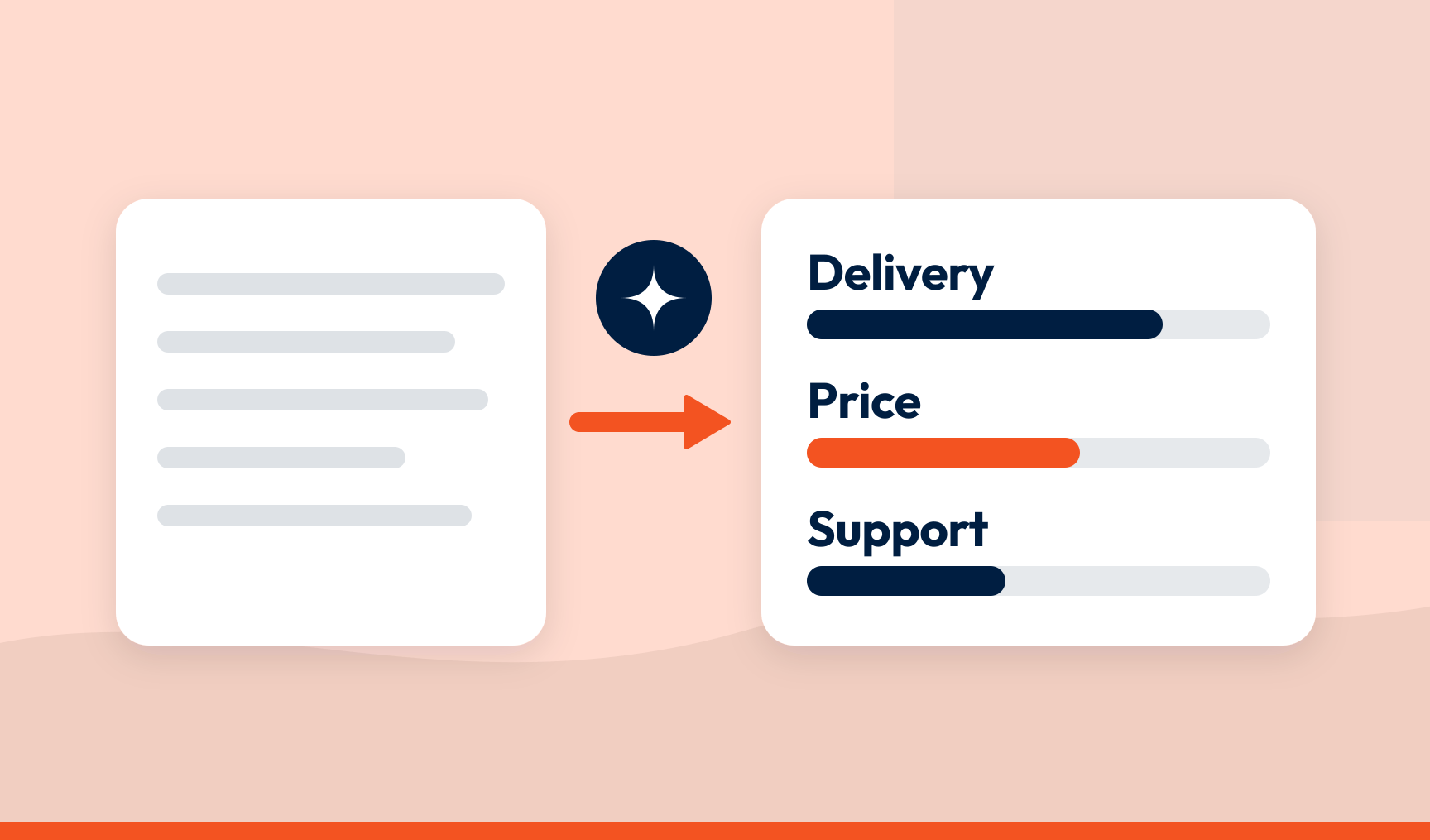
Good AI text analysis turns every comment into structured data you can count, compare and trace back to the words. It applies one method to every source, stores the result so you can look back, and ranks what matters by how much it moves your scores. Bad AI text analysis reads your feedback and tells you what it thinks. The difference is whether there is a structured dataset, with topics and sentiment applied, sitting underneath.
Key takeaways
- The clever part is not the reading. It is the structuring. Every comment broken into mentions, each mention filed under one topic and scored for sentiment, all of it stored
- One method across surveys, reviews, tickets and social, or you have three versions of the truth and a very long meeting
- If you cannot click from a number to the comments behind it, you cannot defend the number
- Topics should come from your feedback, not from a library someone built for a different business
- A tool that produces a plausible paragraph is not the same as a tool that produces a trend
Every platform on your shortlist will show you a demo where feedback goes in and themes come out. They will all look about the same, because the reading part is now cheap. Any large model can read 5,000 comments and tell you people mention delivery a lot.
The question is what you can do with that next quarter. Can you show delivery complaints falling after the fix? Can you click into the number and see the 214 people who said it? Can a colleague in finance get the same figure from Power BI that you got from the dashboard?
That is what separates text analysis you can act on from text analysis you can nod at.
The structuring is the product
Think of feedback in three states.
Unstructured is where it starts. Survey comments, app store reviews, support tickets, social posts, transcripts. Thousands of them, in whatever words people chose, sitting in five systems that don’t talk to each other.
Structured is what a platform should make of it. Every response translated into one language so the same analysis applies across the whole set, and enriched with context such as who said it, on which channel, from where. Then broken into mentions, the individual phrases where someone says one thing about one topic. Each mention filed under a single topic and scored for sentiment, using one method for all of it, and stored with a permanent ID.
CX intelligence is what you get from the structured layer. Which topics drive your scores, ranked by impact. Trends over time. Summaries that point you to where to look. The comments behind any number, one click down. And the results pushed out to the tools your teams already use.
Most AI text analysis demos show you the first and third states and skip the middle. The middle is the bit that holds up when someone asks a hard question.
What separates good from bad
One method, every source
Feedback arrives from everywhere and each channel usually has its own tool with its own idea of what counts as a topic. The survey platform says ‘Service’. The review tool says ‘Staff attitude’. The ticketing system has a dropdown someone set up in 2019. Put them in one deck and the totals don’t add up, so nobody trusts any of them.
Good analysis applies the same categorisation to every source. A complaint about wait times means the same thing whether it came from a survey, a review or a ticket, and it counts once. That is what makes a topic trend a trend rather than three overlapping guesses.
Stored, so you can look back
Here is the test that catches most tools. Ask what the sentiment on ‘checkout’ was in March.
A tool that reads feedback on demand can only answer by reading it again, and there is no guarantee it will file the same comments the same way twice. A platform that stores every mention with its topic and sentiment simply looks it up. March is March, and it stays March.
Complete historical data is what lets you say a driver has fallen since the fix. Without it, every period is a fresh opinion and nothing can be tracked. It is also the difference between a feedback tool and a data foundation, which is what SmartCX gives every team, one trusted data foundation for every dashboard, decision and action.
Every number traces back to the words
An analyst presents ‘delivery delays drive 22% of detractors’ and someone on the board asks how they know. There are two possible answers. One is a list of 214 comments. The other is ‘the AI said so’.
Good analysis lets you drill from any topic, any driver, any summary, straight down to the verbatims. Not exported, not sampled, the actual phrases people wrote, with their sentiment attached. Drilling down to the verbatim is what makes the machine’s work checkable, and checkable is what makes it defensible. The five tests any categorisation should pass, and why a mention belongs to exactly one topic, are covered in how to categorise open-text responses at scale.
Ranked by what moves the score
A list of topics sorted by volume tells you what people talk about. Delivery, again. A list ranked by impact tells you what is actually moving your NPS or CSAT. Impact combines how many people mention a topic with how strongly they feel about it, so a smaller topic with fierce sentiment can outrank a bigger one that is mildly annoying.
That ranking is key driver analysis, and it is what turns a pile of themes into a short list with a fix at the top of it. Add where in the journey each driver shows up and you also know which team the fix belongs to.
Topics that sound like your respondents
Some tools arrive with a library of categories built for the industry, or for a different company entirely. It looks efficient on day one. Then your respondents keep mentioning something the library has no drawer for, and it lands in ‘Other’.
Good analysis discovers topics from your own feedback, so the categories reflect how your respondents actually talk. And when your team wants to track something specific, a new product line, a policy change, they should be able to add a category and see it applied consistently from then on.
The four ways tools read text
| Method | How it works | Where it fails |
|---|---|---|
| Keyword and rules | Matches words from a list and counts them | ‘Delivery was great’ and ‘delivery was NOT the issue’ both count as delivery. Needs a person maintaining the list forever |
| Trained classifier | Learns from feedback a human has already tagged | Needs a lot of tagged examples to start, and drifts as language changes |
| General LLM, on demand | Reads the text and describes what it finds | Produces text, not data. Nothing stored, nothing to compare, and a different reading next time |
| Purpose-built platform | Structures every comment into stored, classified, scored mentions, using models where they help | Only as good as the drill-down. If you can’t see the verbatims, you can’t check it |
The last row is the one to buy, and the last column is the thing to check in the demo.
One detail worth understanding. In a well-built platform, filing a mention under a topic is a matching step, comparing the meaning of the phrase against the set of topics, rather than asking a model to write an answer. A second pass re-reads mentions against the full topic set to catch anything misfiled. Nothing is invented at that step. Models still do the reading, the sentiment and the summaries, which is why the drill-down matters so much. What accuracy can and cannot mean for this kind of analysis has its own honest answer.
Then it has to go somewhere
Structured feedback that lives only in the analysis tool is a very tidy silo.
The last thing to check is whether the results travel. Into the BI tools where decisions get made, Power BI next to churn and revenue, so the outer loop can see what is driving the numbers. Into case management, workflows and the CRM where action gets taken, so the inner loop can resolve the individual problem while the person is still a customer. Good platforms connect to your stack through native integrations and an API, and the same structured data feeds all of it, which is why the figure in Power BI matches the figure in the dashboard.
That is the whole point of doing the structuring once. Every team works from one foundation, and the numbers hold up wherever they are used.
That’s how SmartCX is built. One method across every source, every mention stored with its topic and sentiment, drivers ranked by impact, and one click from any number to the words behind it. See it on real feedback in our product tour.
Frequently asked questions
What is AI text analysis for customer feedback?
The use of language models and classification to turn open-text comments from surveys, reviews, support tickets and social posts into structured data. Each comment is broken into mentions, each mention is filed under a topic and scored for sentiment, and the results are stored so they can be counted, compared over time and traced back to the original words.
What should you look for in an AI text analysis tool?
Four things. One method applied to every feedback source. Storage of every mention with its topic and sentiment, so you can look back and track trends. Drill-down from any number to the verbatims behind it. And a ranking of topics by impact on your scores, not just by volume.
Why does traceability matter in AI feedback analysis?
Because a number nobody can check is a number nobody will fund a decision on. If a topic count or a driver can be clicked open to show the actual comments and their sentiment, the analysis can be verified by anyone, which is what makes it defensible in front of a board or a regulator.
Can a general-purpose LLM do text analysis on customer feedback?
It can read feedback and describe what it finds, which is useful for a quick first look at a small batch. It does not produce a stored dataset, so there is nothing to compare against next quarter and nothing to drill into. Purpose-built platforms use models for the reading but structure and store the results.
Should topics be predefined or discovered from the feedback?
Discovered, with the option to add your own. Topics found in your own feedback reflect how your respondents actually talk and catch themes nobody predicted. Adding categories on top lets your team track the specific things it cares about, applied consistently across every source.
SmartCX is the VoC platform that helps CX teams turn feedback data into CX intelligence the whole business can act on. Watch the product tour or talk to us about what your feedback looks like once it is structured.