
A score tells you something is wrong. It has never once told you what.
The reason is always further down, in what people said, and most programmes stop one level too early. They get as far as the topic, fix what the topic seems to say and wonder why the score doesn’t move.
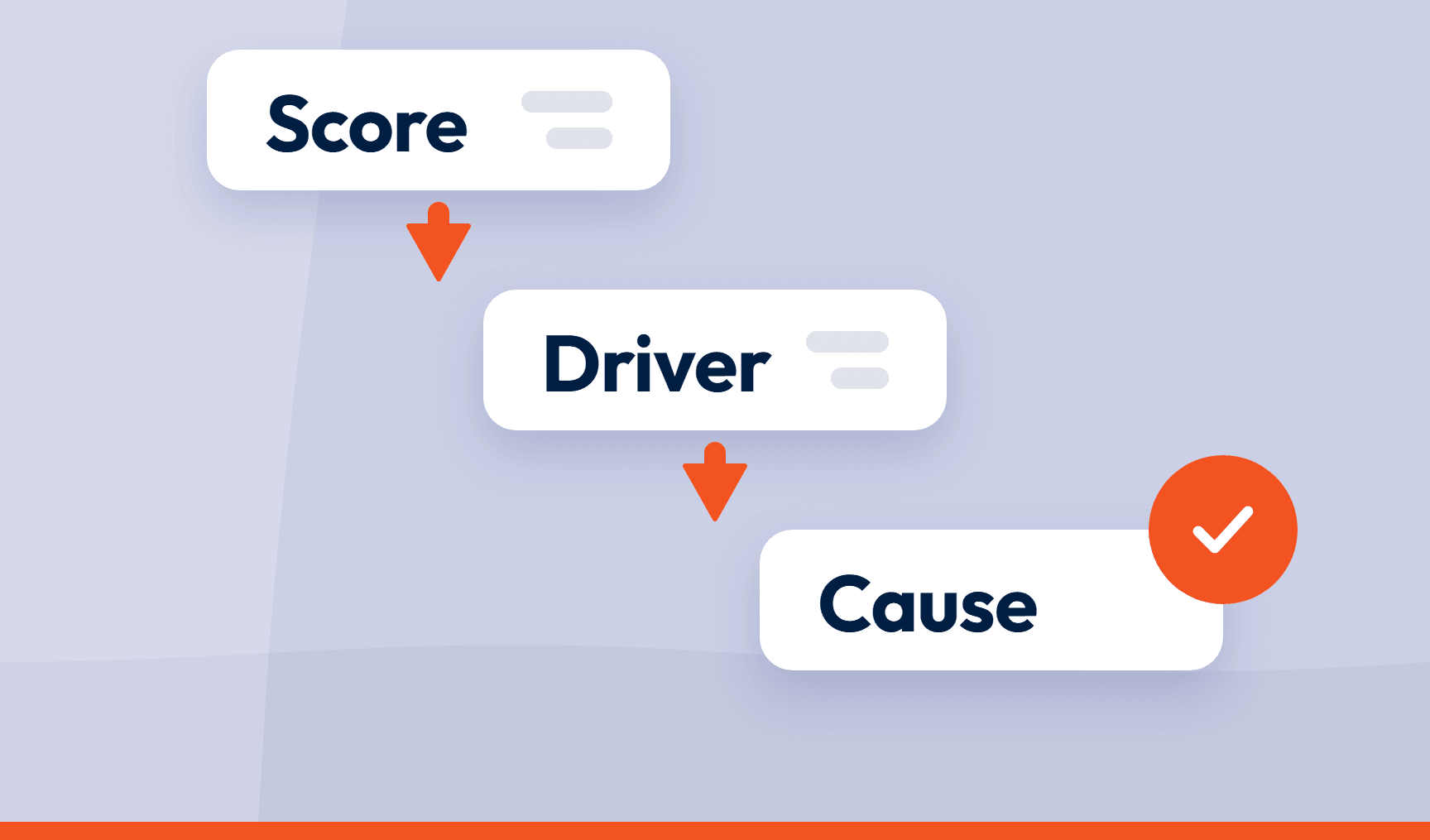
You find the root cause of a score change by drilling down through its key drivers, one step at a time. First comes the topic that moved the score, then the people and places affected, then the comments that explain why.
That drill-down is what makes CX intelligence actionable, because it ends in something a team can fix.
Key takeaways
- You find the root cause of a score change by drilling down through its key drivers, one step at a time. First comes the topic that moved the score, then the people and places affected, then the comments that explain why.
- A topic is usually a symptom. “Waiting times” says where it hurts, and the root cause is whatever is making people wait.
- Business context narrows the search for a root cause. Knowing which sites, channels or groups are affected often points at the cause before you read a single comment.
- Finding a root cause usually takes a few dozen comments from the affected group, read in full, because by then the topic has already been sized and you are reading to understand.
- A fix is confirmed when mentions of the topic fall in the places you changed and stay level in the places you didn’t.
Why can’t a score tell you the root cause?
Because a score records how people feel, and the root cause is in what happened to them.
Satisfaction is down four points. Down because of what?
Take a pharmacy chain whose satisfaction score has slipped over the summer. The score says people are less happy. It doesn’t say whether to look at prices, staff, stock or the car park.
The way down from the score is a drill-down through its key drivers, taken in steps. Each step rules things out, until what’s left is a sentence somebody can act on.
How do you drill down through key drivers to the root cause?
In three steps, each one narrower than the last.
From the score to the key driver
Start with the key drivers, which are the topics that moved when the score did. At the pharmacy chain most topics are flat. One isn’t. Mentions of waiting for prescriptions have nearly doubled, and almost all of them are negative.
That topic is the key driver. The comparison only holds if “waiting for prescriptions” has meant the same thing all year, which is the job of your taxonomy.
The same first step works whatever the score, and it’s how you find out why your NPS dropped.
From the topic to the people and places
Now ask where. Split the topic by business context, which here means store, region and time of day.
The pharmacy chain has 300 stores. The rise is in 40 of them.
Whatever those 40 have in common is the next thing to find, and it won’t be on a feedback dashboard. Operations know it straight away. All 40 moved to a central dispensing hub in June, where prescriptions are made up and sent out to the stores.
From the places to the comments
Then read what people at those 40 stores said. Drill down to the verbatim and a pattern turns up within the first dozen comments.
“Got the text saying it was ready, turned up and waited 20 minutes.”
“Why text me if it isn’t there yet?”
The text goes out when the hub dispatches the prescription, and not when it reaches the store. That’s the cause. People aren’t cross about waiting. They’re cross about being told they wouldn’t have to.
What is the difference between a symptom and a cause?
A symptom is what people complain about. A cause is what you’d have to change for the complaints to stop.
“Waiting for prescriptions” is a symptom. Stop there and the obvious fix is more staff on the counter in 40 stores. That’s expensive and it wouldn’t help, because the prescriptions aren’t in the building. You’d have more people available to explain that it isn’t ready.
The cause is the timing of one automated text. Fixing it means changing when the message is sent.
A useful test is to keep asking why of the topic until the answer is something a team could change on Monday. If the answer is still a feeling, keep going.
How many comments do you need to read?
Fewer than you’d think, as long as they come from the right place.
The sizing has already been done. You know how many people raised the topic and where they are. You’re reading now to understand, and that comes quickly. As a rule of thumb, a few dozen comments from the affected stores is plenty. When the last ten tell you nothing the first twenty didn’t, stop.
Read them whole, though. The cause is often in the half of the sentence that isn’t about the topic. In “waited 20 minutes after the text said ready”, the clue is the second half.
Then read a handful from the stores that aren’t affected. If people there are quietly happy with collection, you’ve confirmed where the difference lies.
What if the cause sits outside the CX team?
It usually does. The CX team found this one, and the fix sits with whoever runs the dispensing hub and its messages.
So what you hand over matters. A line such as “prescription waiting complaints have doubled in the 40 hub stores, and here are 30 people saying the ready text arrives before the prescription does” gets you a meeting in a way that “satisfaction is down” never will.
Bring the number, the places and the comments. Leave any theory about fault at home. The hub was a sensible decision with one loose end, and the team that built it will want to tie it off.
How do you know the fix worked?
Watch the same topic in the same places.
The pharmacy chain changes the text so it goes out when the prescription is scanned in at the store. If the timing was the cause, mentions of waiting for prescriptions will fall in the 40 hub stores within a few weeks and stay level everywhere else.
The score follows later. Check the topic first, because it moves sooner and it’s the thing you changed. That before-and-after comparison is how you prove the fix worked.
If mentions don’t fall, you found a cause and not the cause. Go back to the comments.
How SmartCX helps
SmartCX is the CX intelligence platform that helps CX teams turn feedback data into intelligence the whole business can act on. Its key driver analysis is a drill-down in steps. You go from a score to the topics moving it, then split any topic by business context such as site or channel, then drill down to the comments behind the number. That’s how you uncover insights a team can fix as well as report.
Frequently asked questions
How do you find the root cause of a change in a score?
You drill down through the score’s key drivers in steps. Find the topic that moved when the score did, then the people and places where that topic is concentrated, then read the comments from those people. The root cause is usually in what the comments have in common.
What is the difference between a key driver and a root cause?
A key driver is the topic that moves a score, such as waiting times. A root cause is the reason that topic is being raised, such as a message sent at the wrong moment. Key drivers tell you where to look. Root causes tell you what to change.
How many comments should you read to find a root cause?
A few dozen comments from the affected group is usually enough. Read them in full, and stop when new comments repeat what earlier ones said. Read a few from unaffected groups to confirm the difference.
Can AI find the root cause for you?
AI can find the topic driving a score, show where it is concentrated and summarise what people said. Confirming the cause still takes someone who knows the business, because the explanation often lies in an operational change the feedback never names. SmartCX is the CX intelligence platform that helps CX teams turn feedback data into intelligence you can act on, and it takes you from a score to the comments behind it.
Want to see how it works? Watch a tour or talk to us.