
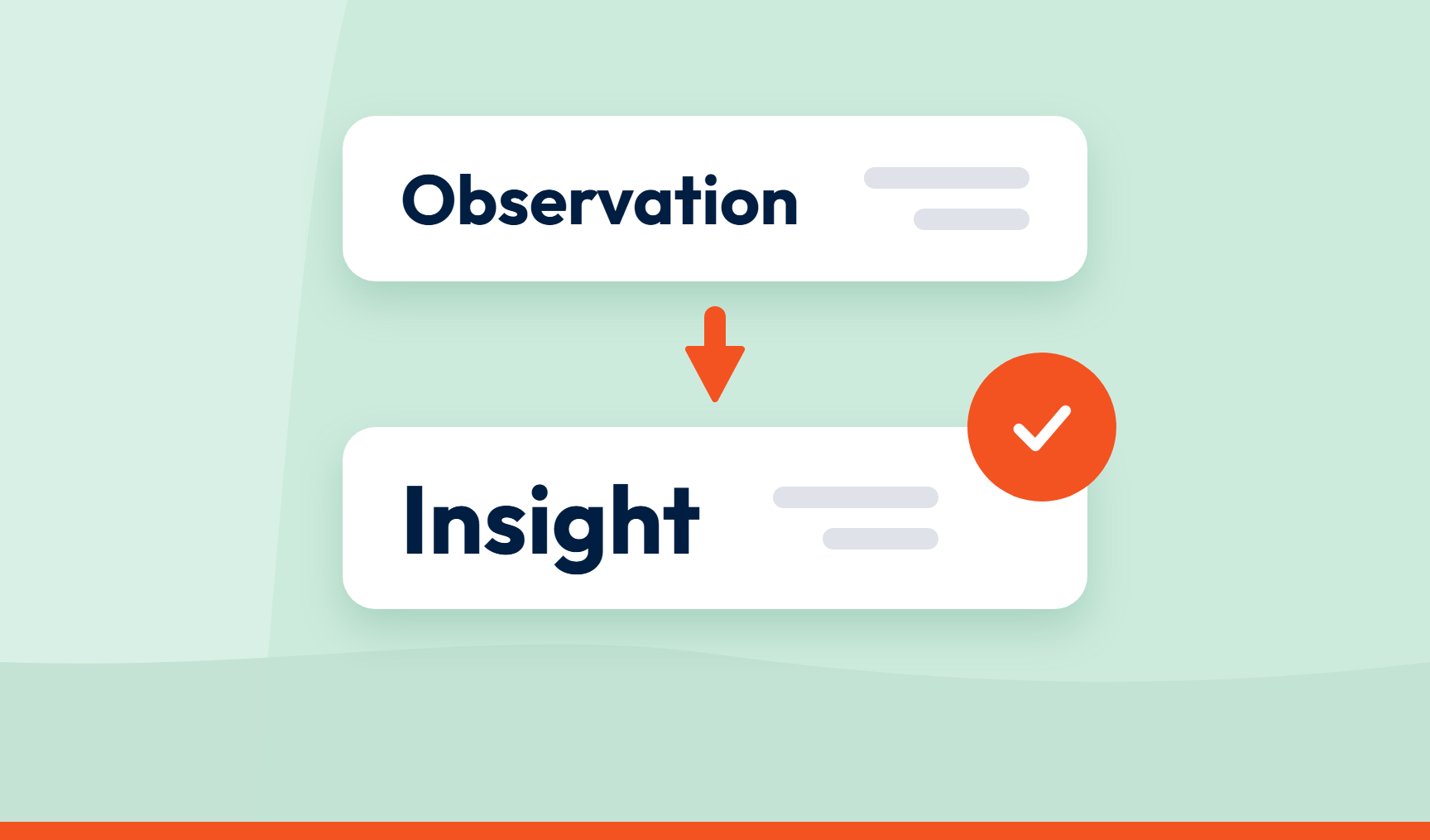
“Customers are unhappy with delivery.” Probably true. Also no use to anyone on Monday morning.
Compare it with this: “Missed delivery slots in the North West doubled after the courier change, and here’s what people said.” Someone can act on that.
Actionable customer insights are specific findings, backed by what customers actually said, with a named owner and a place where that owner already works. A useful insight explains the problem. An actionable insight also makes clear who can address it and where the next action should happen.
Key takeaways
- Most “insights” are observations. Actionable customer insights have four things: a specific issue, evidence, an owner and an address.
- Specific means what, where, how much and since when, backed by evidence down to the verbatim.
- Owners are people or teams with authority to fix the problem, which often sits outside CX.
- An insight needs to arrive where its owner already works, not in a tool they never open.
- A quick test: can the recipient say what to do next?
From observation to insight
The two look similar on a slide. The difference is in the detail. The figures below are illustrative.
| Ingredient | Observation | Actionable insight |
|---|---|---|
| Issue | Delivery is a problem | Missed delivery slots in the North West |
| Size and timing | Some complaints | Complaints doubled since the courier change in March |
| Evidence | Customers are unhappy | Verbatim comments describe waiting in all day for a slot that wasn’t kept |
| Owner | Someone should look at this | Regional logistics manager |
| Address | It’s in the quarterly deck | A ticket in the queue the logistics team already uses |
The four ingredients
1. A specific issue
Say what’s happening, where, how big it is and when it started. Vague findings can’t be prioritised, because nobody knows whether they matter. SmartCX automatically categorises feedback into topics, and key driver analysis shows which topics are pulling your key metrics up or down, and by how much, so you know where to act first.
2. Evidence down to the verbatim
An owner who can read what customers actually said doesn’t have to take your word for it. Every insight traces back to the verbatims behind it, which turns “we think” into “here’s what they wrote”. It also protects the finding when someone asks where it came from.
3. A named owner
“The business” can’t act. A person or team can. Ask who has the authority to change the thing in question. Often it isn’t CX. It might be logistics, product, a branch network or a contact centre. Name that function in the insight.
4. An address
An owner needs the insight where they already work: in the CRM, helpdesk or BI dashboard they use to make decisions. CX intelligence buried in a tool nobody opens is unlikely to prompt action. SmartCX connects to CRM, helpdesk and BI tools, including Power BI, so CX intelligence can reach the teams responsible for the fix.
Cases and patterns
The same principle applies to individual cases and recurring patterns. A case needs an owner who can resolve one customer’s issue. A pattern needs an owner who can change the process behind it. Both need specific evidence and a clear route to action. The overview of the two loops is in closing the loop in customer experience.
A quick test
Hand the finding to someone who hasn’t seen it and ask:
- What’s wrong?
- How big is it?
- Where’s the proof?
- Whose job is it?
- What happens next?
If any answer is “I’d have to find out”, it isn’t actionable yet.
When a good insight still stalls
Even a well-formed insight doesn’t guarantee action. The next challenge is getting people to agree on what needs to change and commit to doing it. That’s a separate challenge, covered in using CX data to influence stakeholders and prove your impact. This article is about making sure the insight is ready before that conversation starts.
What you can do right now
Take your most recent CX report and choose one finding. Run it through the five questions above. Wherever you hit “I’d have to find out”, fill the gap before the report goes anywhere.
How SmartCX helps
For CX leaders and managers who need to turn scattered feedback into decisions the business acts on, SmartCX gives every team one trusted data foundation for every dashboard, decision, action and AI workflow.
SmartCX, a VoC platform, brings surveys, reviews, support tickets, call transcripts and behavioural signals into one place and categorises feedback automatically, and every insight traces back to the verbatims behind it. Teams can create custom reports and dashboards and send them to the tools their teams already use, and SmartCX pushes insights into the CRM, helpdesk and BI tools, so teams get actionable intelligence where they work. See it in a product tour.
Frequently asked questions
What makes customer insights actionable?
A specific issue, evidence from what customers said, a named owner, and a place where that owner already works. Without all four, it’s an observation.
What’s the difference between an observation and an insight?
An observation says what you noticed, such as “customers are unhappy with delivery”. An insight says what, where, how much and why, with evidence and an owner.
What is actionable intelligence?
Customer findings that someone can act on without further digging: specific, evidenced and delivered to the person who can fix the problem.
Who should own a customer insight?
The person or team with authority to change the thing it describes. That’s often outside CX, such as logistics, product or operations, so name that function in the insight.
How specific does an insight need to be?
Specific enough that the recipient can say what’s wrong, how big it is and what to do next. Include what, where, how much and since when.
Why do customer insights go unused?
Common reasons are no named owner, the insight arriving somewhere the owner never looks, and evidence too thin to convince. Fixing the shape of the insight helps with all three.
Want to see how it works? Watch a tour or talk to us.