
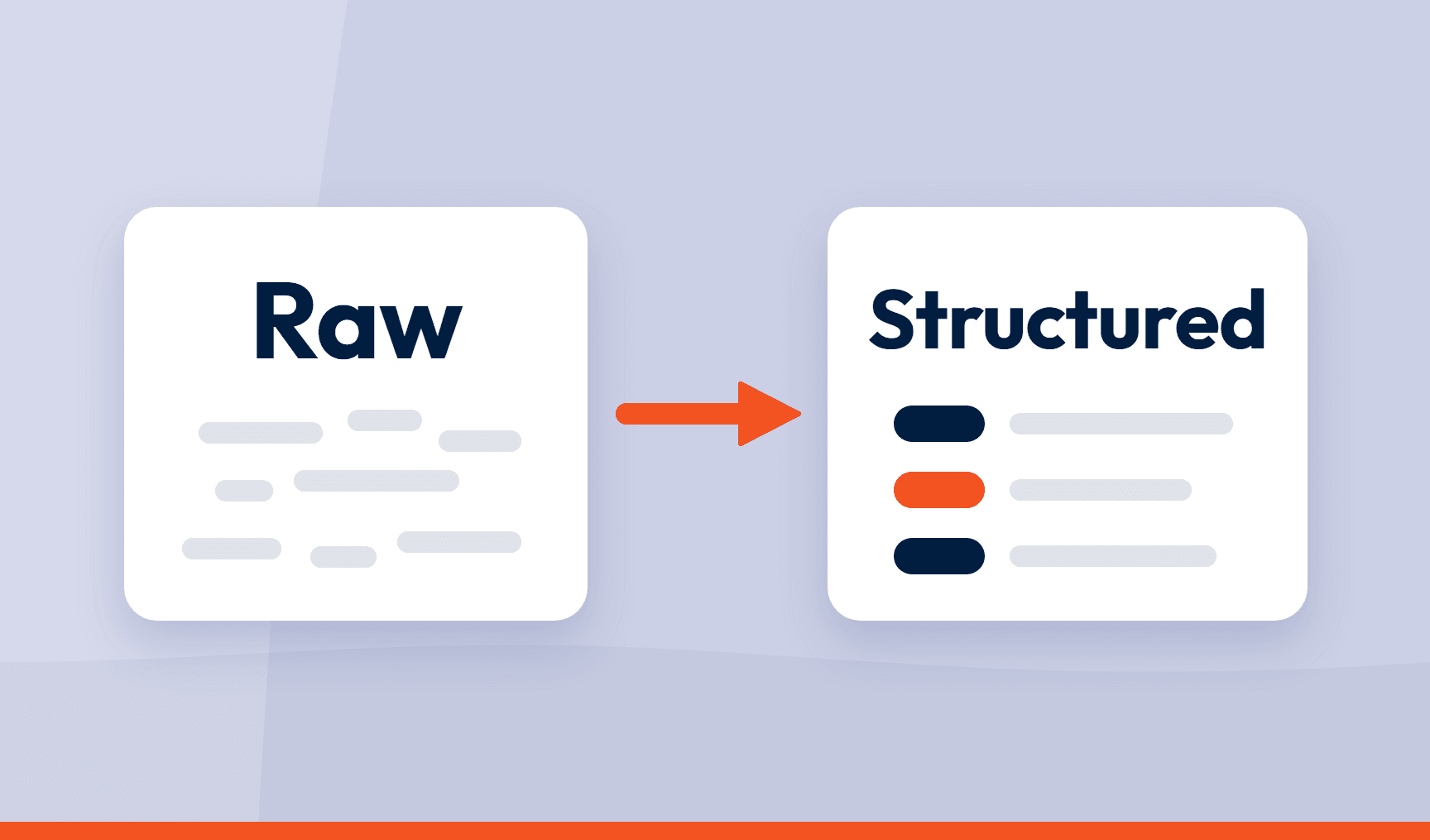
You can analyse feedback straight from the raw comments, or you can structure it first. Only one of those gives you the same answer next month.
Unstructured feedback is anything people tell you in their own words. Structured feedback is the same feedback once every comment carries topics from a consistent taxonomy, a sentiment and business context, and is stored so that every report draws on the same data.
That stored, structured version is your data foundation. Reports, dashboards and AI assistants all sit on top of it, and your CX intelligence is only as steady as what’s underneath.
Key takeaways
- Unstructured feedback is anything people tell you in their own words. Structured feedback is the same feedback once every comment carries topics from a consistent taxonomy, a sentiment and business context, and is stored so that every report draws on the same data.
- A structured data foundation is built by running feedback through a consistent taxonomy, applying sentiment to each phrase, adding business context and storing the result.
- Sentiment belongs to the phrase and not the whole comment, because one comment often praises one thing and complains about another.
- Analysing raw comments from scratch each time means topics shift between one analysis and the next, so two months can’t be compared.
- Copilot, Claude and ChatGPT are good at summarising and building slide decks. They track trends reliably only when they query a structured data foundation and not a pile of raw comments.
What is unstructured feedback data?
Unstructured feedback data is everything people tell you without being handed a box to tick. That covers survey comments, reviews, support cases, call transcripts and social posts.
Most organisations collect feedback through surveys and receive a good deal more through reviews, calls and social that nobody asked for.
None of it has a fixed shape. One person writes four words. Another covers the seats, the sound and the price of popcorn in a single sentence with no punctuation.
A cinema chain receives 40,000 comments a month. Unstructured, that’s 40,000 separate things to read, and the team has time for about 200 of them.
The reasons behind every score are in there. They’re just not in a form anyone can analyse twice and get the same result.
What does a structured data foundation look like?
It looks like the same 40,000 comments with the same things recorded against every one, kept in one place.
Topics from one taxonomy
Every comment is run through the same taxonomy, so each topic means one thing wherever it turns up. Sticky floors is sticky floors in a review, a survey comment and a call transcript.
AI text analysis does this for every comment, so nothing depends on which 200 somebody happened to read.
Sentiment on each phrase
People rarely feel one way about a whole visit. “Loved the film, the seats were filthy and the popcorn cost more than the ticket” is one comment holding one compliment and two complaints.
Score the whole comment and you get “mixed”, which helps nobody. Score each phrase and the film gets its praise, cleanliness gets its complaint and so does pricing.
The popcorn has always cost more than the ticket. Now it’s on the record.
Business context
Each comment also carries the facts around it, such as the site, the screen, the date and the channel it came through. Context is what lets you ask where and when, and get a narrower answer than “everywhere, lately”.
Stored so you can go back to it
The last part is the least glamorous and it matters most. Once a comment has its topics, sentiment and context, the result is kept.
Next month’s report reads the same record as this month’s, with a month of new comments added. Nothing is worked out again from scratch.
Why not analyse the raw comments each time?
Because the analysis starts from nothing every time, and it doesn’t land in the same place twice.
Say the cinema chain analyses its raw comments in May and finds that cleanliness is the top complaint. In June the same exercise groups things a little differently. Floors and toilets are now two issues, and seating has absorbed some of what used to be cleanliness.
Did cleanliness improve in June? Nobody can say. The comments were sorted into different piles, so the two months can’t be laid side by side.
| Raw comments, analysed each time | A structured data foundation | |
|---|---|---|
| Topics | Decided afresh on every run | Fixed in your taxonomy |
| Last month’s analysis | In a slide deck somewhere | Stored and still there |
| Trends | Two snapshots that don’t match | The same topics followed over time |
| Checking a number | Read everything again | Drill down to the comments behind it |
A trend needs the same thing measured the same way twice. Raw analysis gives you a new measurement each time and calls it a trend.
Where do Copilot, Claude and ChatGPT fit?
On top of the data foundation, where they’re very good.
An AI assistant is excellent at summarising and at building a slide deck. Hand it a pile of raw comments, though, and it has to do the structuring and the reporting in one go. It does the structuring differently each time you ask.
Point it at structured data and the job changes. SmartCX connects to Copilot, Claude, ChatGPT and other assistants through MCP, the Model Context Protocol, which is a standard way for an assistant to query another system’s data. The assistant asks the foundation and no longer has to work the answer out for itself.
So you can ask what changed at your city-centre sites this month and get an answer built on the same topics and numbers as your dashboard. Ask again next month and the assistant is querying the same data with a month added. It’s tracking the trend, not reclassifying the comments.
The same goes for agents, which are assistants that carry out a task on their own, such as preparing the monthly report. An agent working from a structured foundation produces the same report twice. One working from raw comments produces two interpretations.
The assistant writes the summary and builds the deck. The foundation makes sure the numbers in it are the ones everybody else is looking at.
How SmartCX helps
SmartCX is the CX intelligence platform that helps CX teams turn feedback data into intelligence the whole business can act on. It brings surveys, reviews, support cases and social into one place, runs every comment through your taxonomy, applies sentiment and business context, and stores the result as one data foundation. You can drill down from any number to the comments behind it, or connect an AI assistant and ask. A proof of concept on a few months of your historical feedback is the quickest way to see it.
Frequently asked questions
What is unstructured feedback?
Unstructured feedback is anything people tell you in their own words, such as survey comments, reviews, support cases, call transcripts and social posts. It has no fixed format, so it can’t be analysed consistently until it has been structured.
What is a structured data foundation?
A structured data foundation is a stored record of your feedback in which every comment has topics from a consistent taxonomy, sentiment for each phrase and business context such as the site and the date. Every report and every AI assistant draws on that one record.
Why is sentiment applied to phrases and not whole comments?
One comment often praises one thing and complains about another. A single score for the whole comment hides both. Scoring each phrase attaches the right sentiment to the right topic.
Can Copilot, Claude or ChatGPT analyse your feedback?
They can summarise it and build a slide deck from it. To track trends they need structured data to query, so that next month’s answer is built on the same data as this month’s. SmartCX is the CX intelligence platform that helps CX teams turn feedback data into intelligence the whole business can act on, and it connects to AI assistants through MCP so they query the structured data.
Want to see how it works? Watch a tour or talk to us.